Chiffchaff
Phylloscopus collybita
Print fact sheet (PDF)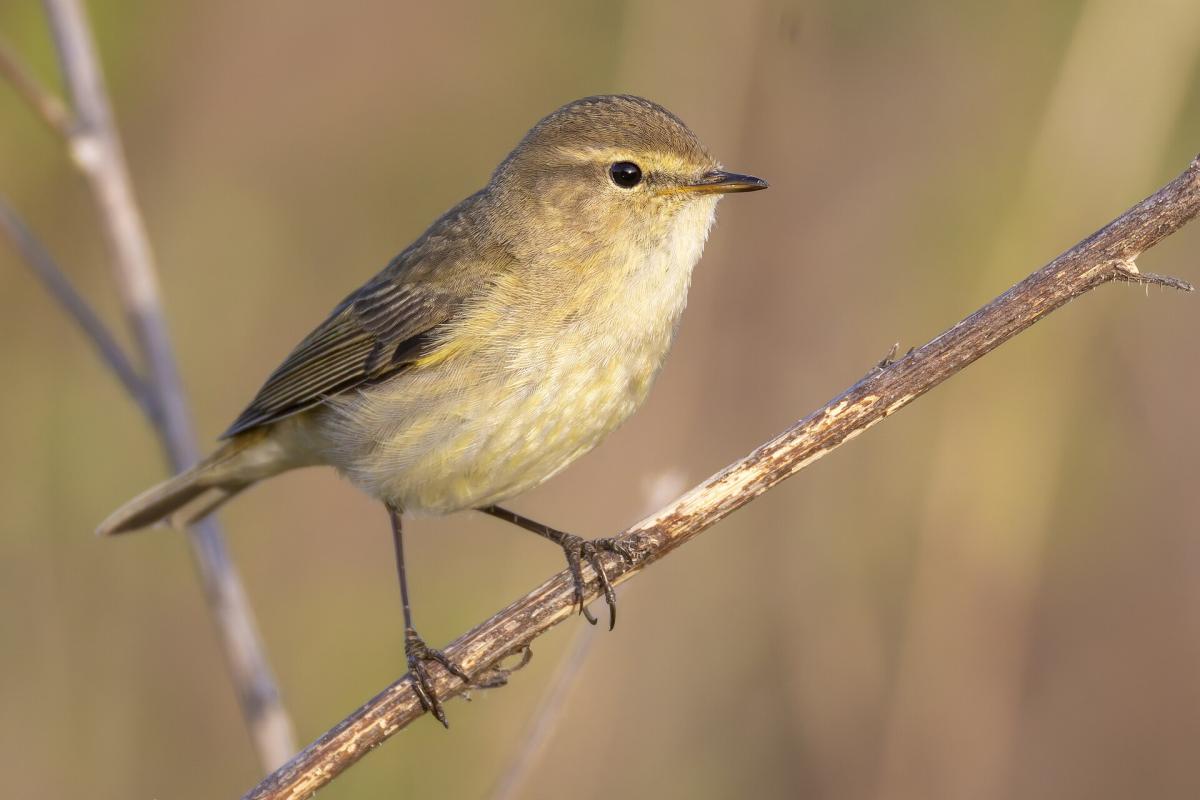
Named after its own song — a flat, insistent 'chiff-chaff' from high in a bare March tree.
A small, plain, olive-brown warbler with a fine bill, a faint stripe over the eye and dark legs. It is very hard to tell from a willow warbler by sight, and even experienced birders rely on the voice. Chiffchaffs are among the first summer migrants back in Dumfries, often singing from the tops of still-leafless trees in the second half of March, in woodland edge, scrub and larger gardens.
Behaviour
The song is exactly the name: a monotonous, slightly hesitant 'chiff-chaff-chiff-chaff' repeated for minutes on end from a high perch, usually with a tail-dip on each note. Chiffchaffs feed restlessly in the canopy and scrub, taking small insects, and flick their wings and tail almost constantly. A few now overwinter in southern Britain rather than migrating at all.
Migration
Most chiffchaffs winter around the Mediterranean and in West Africa, and they are among the earliest migrants to return — the short crossing means they can risk arriving in March, weeks before willow warblers, and claim the best territories.
When to see it
Quick facts
- Family
- Leaf warblers (Phylloscopidae)
- Size
- 10–12 cm · smaller than a sparrow
- UK status
- Green-listed
Photo by Alexis Lours, CC BY 4.0, via Wikimedia Commons