Common Redstart
Phoenicurus phoenicurus
Print fact sheet (PDF)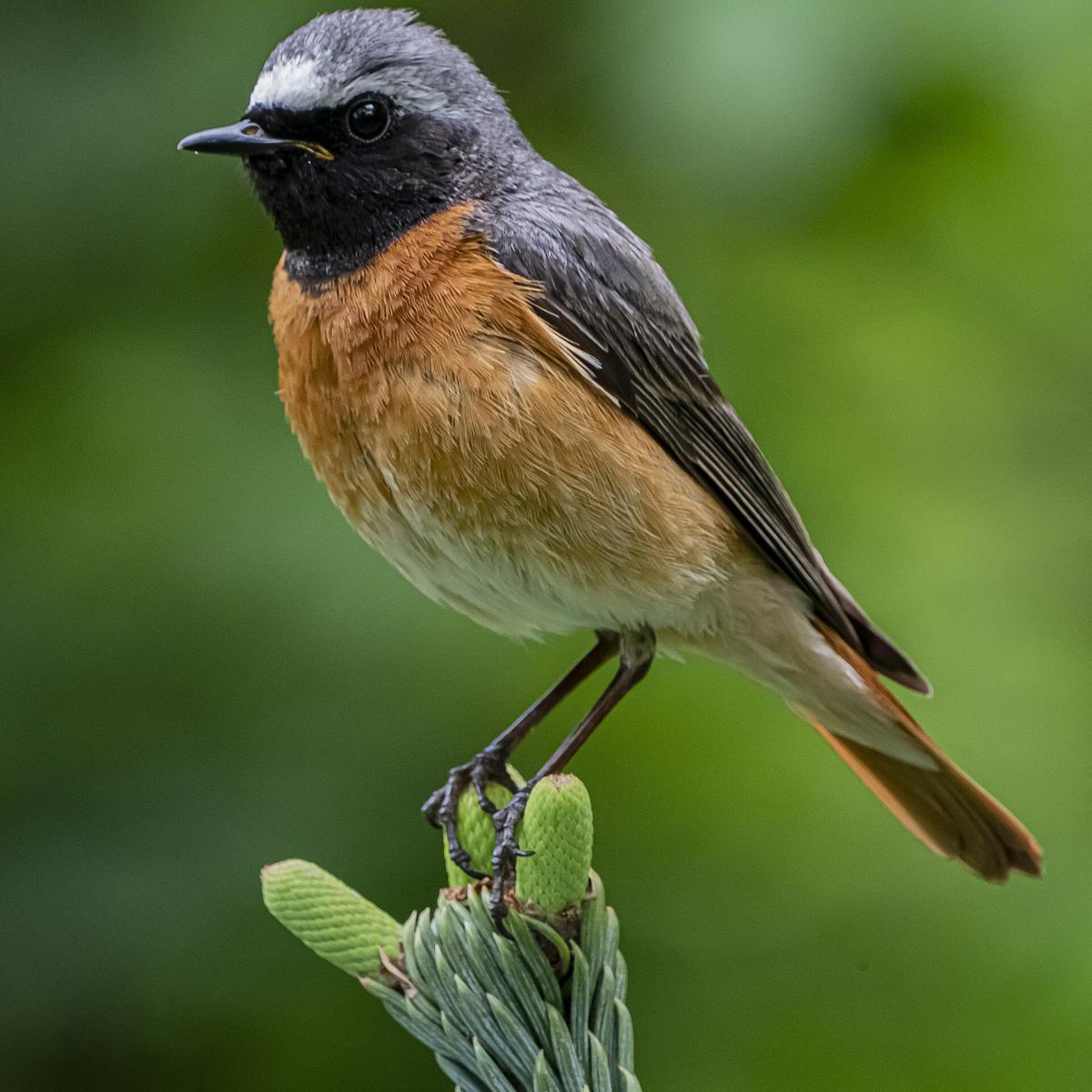
Never quite still — the rust-red tail shivers constantly, even when the rest of the bird does not.
A slim, elegant summer visitor. The male in spring is a genuinely beautiful bird: blue-grey above, black face and throat, orange-red breast and a burning rusty tail. Females are plainer buff-brown but share the same tail. Redstarts breed in open oak and birch woodland, wood pasture and old walls with cavities, and Galloway holds good numbers — they are far commoner west and north of Dumfries than in lowland England.
Behaviour
The constant quivering of the tail is the identification clincher, visible even at distance. Redstarts hunt from a low perch, dropping to the ground for insects or flycatching briefly, and nest in tree holes, wall crevices and boxes. Males sing a short, sweet, slightly melancholy phrase that trails off into a scratchy jumble, usually from a high branch in the first hours of light.
Migration
Redstarts winter in the Sahel savannah south of the Sahara and return through April. Like whitethroats, their numbers here have historically risen and fallen with rainfall in that African wintering belt.
When to see it
Quick facts
- Family
- Chats and flycatchers (Muscicapidae)
- Size
- 14 cm · sparrow-sized
- UK status
- Amber-listed
Photo by Jerzy Strzelecki, CC BY-SA 3.0, via Wikimedia Commons