Common Sandpiper
Actitis hypoleucos
Print fact sheet (PDF)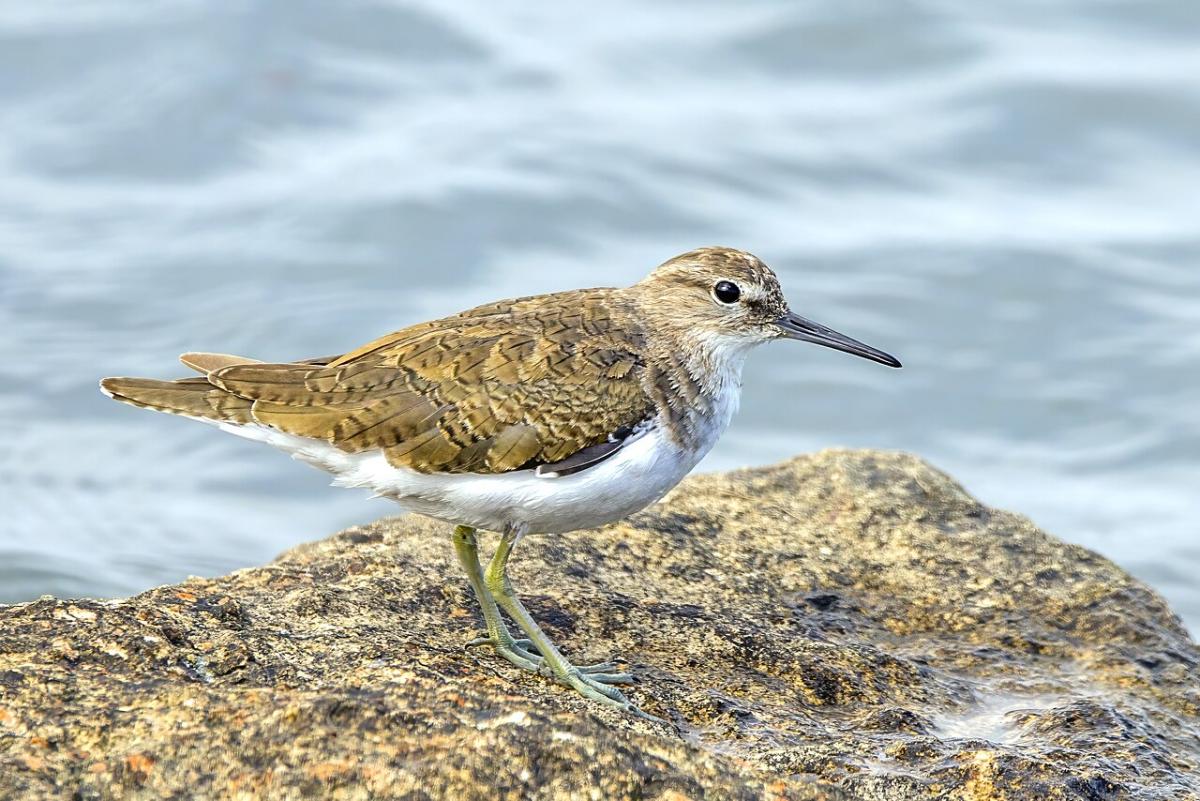
A small, bobbing wader of upland rivers and lochs, gone again by autumn.
The common sandpiper is a slim, short-legged wader with plain brown upperparts, white underparts and a habit of constantly bobbing its tail end up and down as it walks — a tic that makes it identifiable at a glance, even at distance. It's a summer migrant to Dumfries and Galloway, arriving from African wintering grounds in April to breed along the shingly banks of upland rivers, lochs and reservoirs, and departing again by September. Unlike the estuary waders that crowd the Nith in winter, this is a bird of clear, fast-flowing water and quiet loch shores, nesting on the ground close to the water's edge among vegetation. Its low, flickering flight on stiff, bowed wings just above the water surface, interspersed with brief glides, is as distinctive as its call — a piping, three-note whistle often given the moment it's disturbed.
Behaviour
Picks and probes for insects, small molluscs and crustaceans along the waterline, constantly teetering its rear end. Flies low over the water on shallow, fluttering wingbeats broken by short glides, rarely rising far above the surface. Pairs are strongly attached to a stretch of river bank and will return to the same territory each spring.
Migration
Common sandpipers winter in Africa, south of the Sahara. They return to breed along fast, stony rivers and loch shores, bobbing constantly at the water's edge — here for the summer, gone again by early autumn.
When to see it
Quick facts
- Family
- Sandpiper (Scolopacidae)
- Size
- Length 19–21cm, wingspan 32–35cm
- UK status
- Red list
Photo by Charles J. Sharp, CC BY-SA 4.0, via Wikimedia Commons