Common Whitethroat
Curruca communis
Print fact sheet (PDF)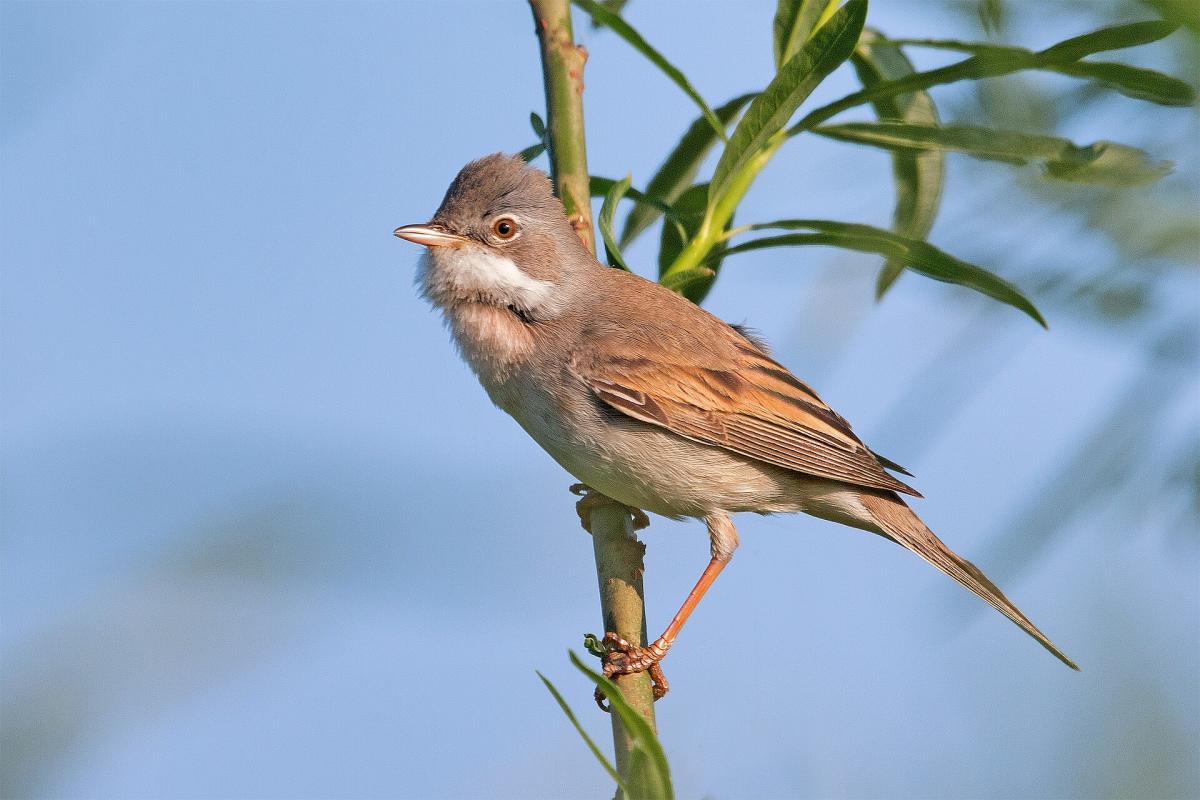
Bursts out of a bramble, sings a scratchy phrase into the air, and drops straight back in.
A lively warbler of hedgerow, bramble and rough scrub, with a grey head, rusty-edged wings, long tail and a clean white throat that it puffs out when singing. Whitethroats arrive in Dumfries from mid-April and take up territory along field edges, disused ground and scrubby riverbank — anywhere with dense low cover and a few song perches. Males are far more visible than females.
Behaviour
The song flight is characteristic: the male launches vertically from a bramble, delivers a hurried, scratchy little phrase while bouncing in the air, then parachutes back into cover. Between flights he sings from an exposed twig with his throat feathers raised. Whitethroats feed on insects low in the vegetation through summer, adding berries before departure.
Migration
Whitethroats winter in the semi-arid Sahel belt on the southern edge of the Sahara. The population crashed catastrophically after drought there in the late 1960s, and numbers in Britain still track rainfall in that region — an unusually direct link between African weather and a Dumfries hedgerow.
When to see it
Quick facts
- Family
- Typical warblers (Sylviidae)
- Size
- 14 cm · sparrow-sized
- UK status
- Green-listed
Photo by Andreas Trepte, CC BY-SA 2.5, via Wikimedia Commons