Fieldfare
Turdus pilaris
Print fact sheet (PDF)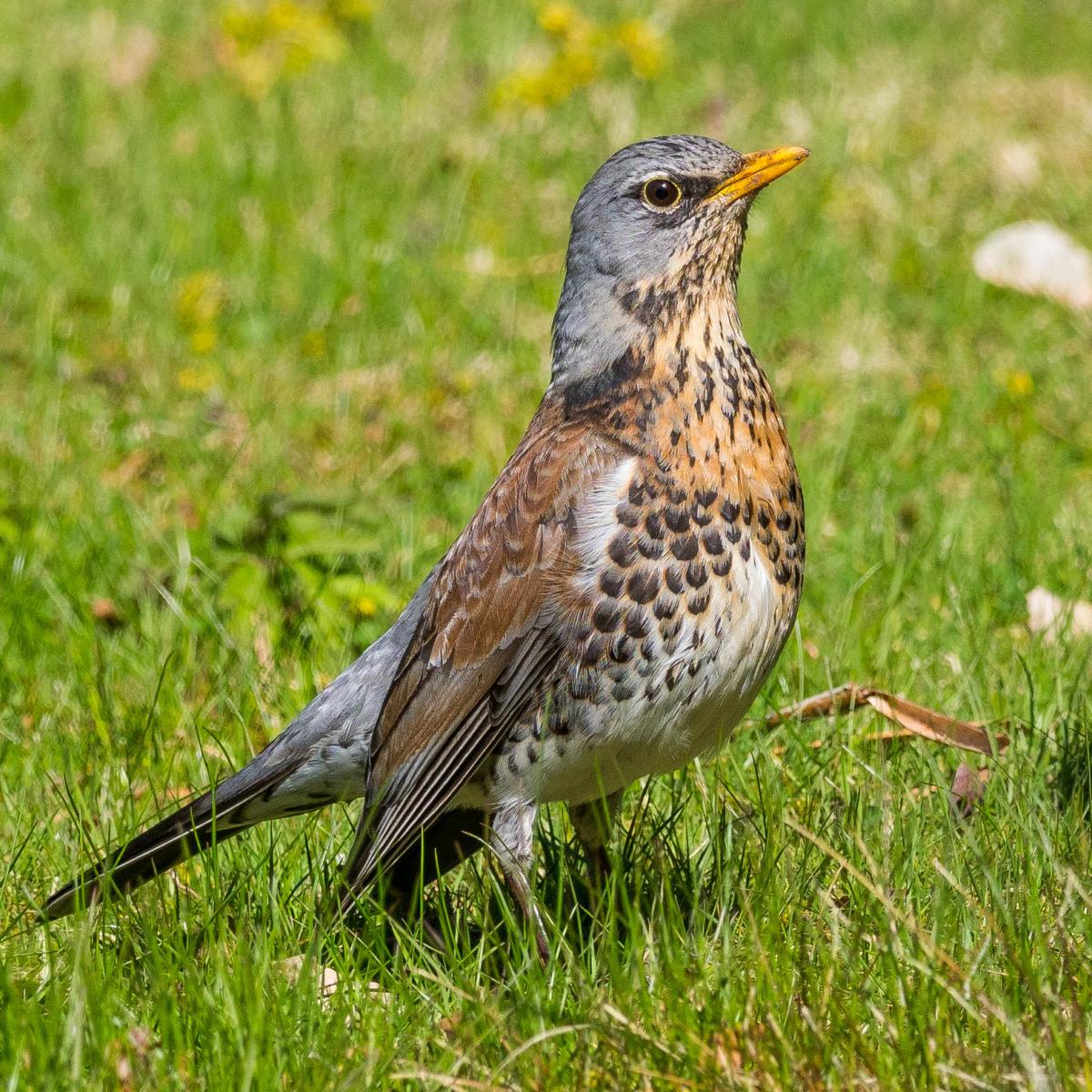
Big, grey-headed northern thrushes that arrive in chattering flocks to strip the hedgerows bare.
A large, upright, handsome thrush: blue-grey head and rump, chestnut back, and a heavily spotted yellow-buff breast. Fieldfares arrive in Dumfries from October, often in loose flocks alongside redwings, and work the hedgerows, orchards and stubble fields around the town. In a hard winter they move into gardens for windfall apples. They leave again through March and April, and none stay to breed.
Behaviour
Fieldfares feed in restless, mobile flocks, moving down a hedge and stripping haws and rowan berries as they go, with a constant hard 'chack-chack' contact call. When berries run out they switch to open grassland and playing fields, hunting worms in a series of upright hops. They are noticeably bolder than redwings and will see off other thrushes from a good fruit tree.
Migration
Fieldfares breed across Scandinavia, Finland and Russia and move south and west in autumn to escape frozen ground. Dumfries sits in comfortable wintering country — mild, damp and hedged — and the size of the influx each year depends largely on how the northern berry crop has fared.
When to see it
Quick facts
- Family
- Thrushes (Turdidae)
- Size
- 25–26 cm · blackbird-sized
- UK status
- Red-listed
Photo by Bengt Nyman from Vaxholm, Sweden, CC BY 2.0, via Wikimedia Commons