Goosander
Mergus merganser
Print fact sheet (PDF)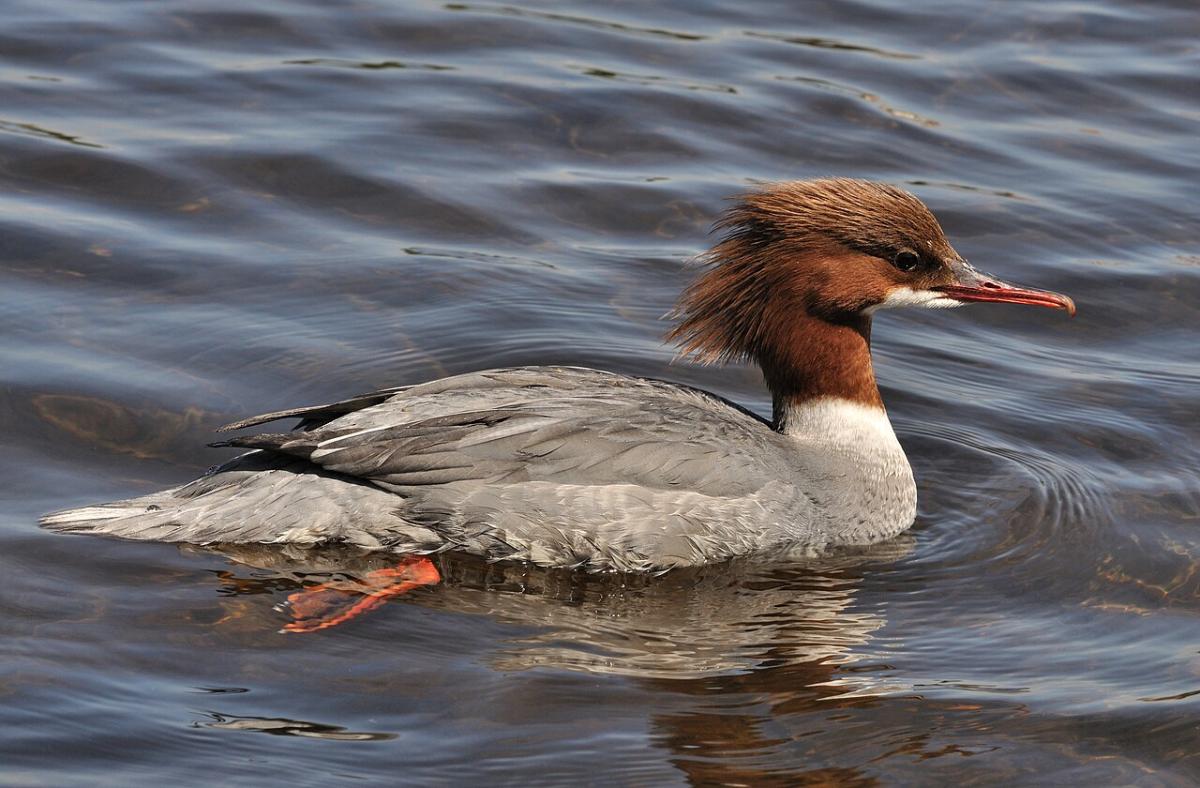
A big, elegant sawbill duck that nests up quiet rivers in summer and gathers on open water once the cold sets in.
Goosanders are the largest of Britain's sawbill ducks, built long and streamlined with a narrow, serrated red bill designed for gripping slippery fish. In summer, pairs breed along Dumfries and Galloway's faster rivers, nesting in holes in riverside trees, and it's a memorable sight to see a line of stripy ducklings hitching a ride on their mother's back soon after hatching. As the rivers cool and food gets harder to find, goosanders move out onto larger lochs and the Nith estuary, where numbers are boosted through autumn and winter by birds arriving from further north — rafts of dozens can gather on open water. Look for the drake's dark bottle-green head and salmon-pink-flushed white body, and the female's neat rusty-red head with a shaggy crest, both diving repeatedly and resurfacing well downstream of where they went under.
Behaviour
Goosanders hunt by sight, swimming with the head submerged to spot fish before diving in pursuit, gripping their catch with the serrated 'sawbill' edge of the beak. Ducklings leave the nest hole within a day or two of hatching and are strong swimmers almost immediately, though they'll still climb onto a parent's back to rest or cross faster water.
When to see it
Quick facts
- Family
- Ducks, geese and swans (Anatidae)
- Size
- 58–66cm · a large sawbill, bigger than a Mallard
- UK status
- Green-listed
Photo by Quartl, CC BY-SA 3.0, via Wikimedia Commons