Great Spotted Woodpecker
Dendrocopos major
Print fact sheet (PDF)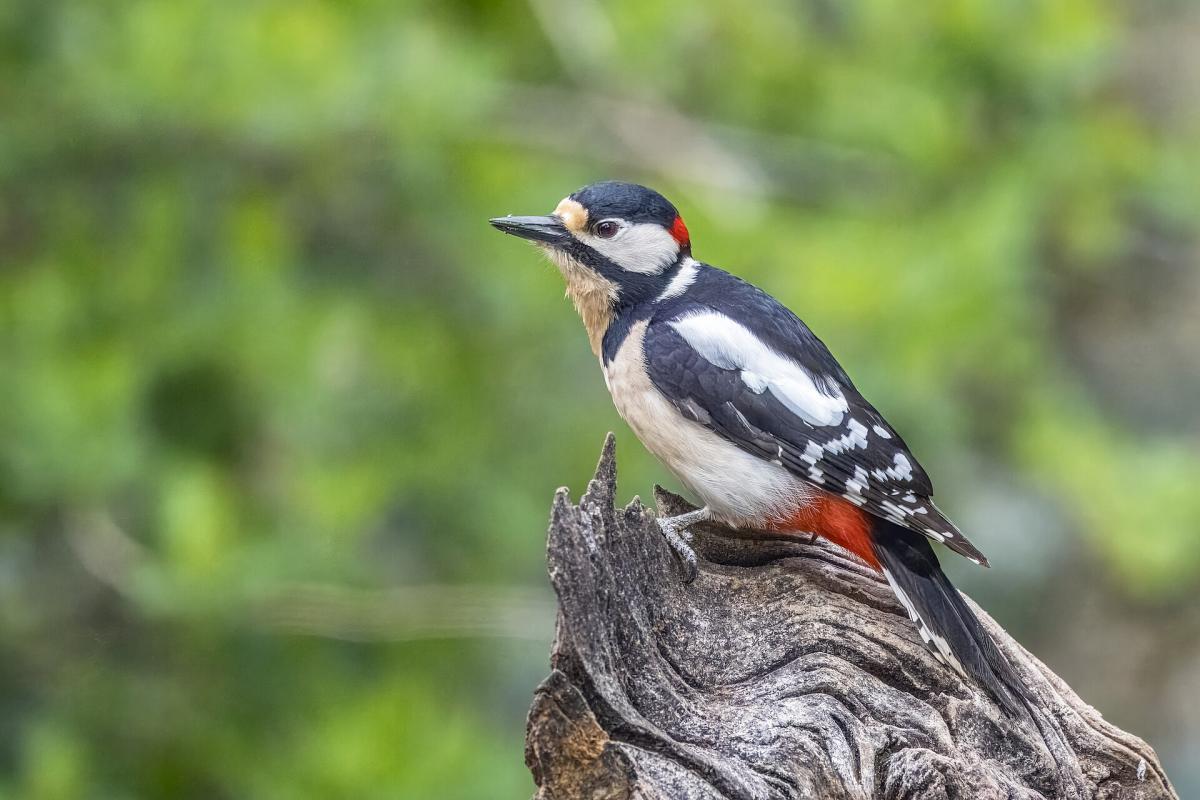
That short, hard burst of drumming in March is not feeding — it is a bird announcing itself.
A boldly pied woodpecker about the size of a blackbird, black above with two large white shoulder patches, white-barred wings and a vivid scarlet patch under the tail. Males have a red nape spot, juveniles a full red crown. Great spotted woodpeckers are common in woodland, parkland and mature gardens around Dumfries and come readily to peanut feeders, especially in winter.
Behaviour
The drumming is a territorial signal, not feeding: a very fast burst lasting under a second, delivered against a resonant dead branch, carrying several hundred metres. Both sexes do it, mostly from January to May. Feeding is by chiselling into bark for grubs and by wedging conifer cones into a chosen crevice — an 'anvil' — to hack out the seeds. They also raid other birds' nest boxes for chicks.
When to see it
Quick facts
- Family
- Woodpeckers (Picidae)
- Size
- 22–23 cm · blackbird-sized
- UK status
- Green-listed
Photo by Charles J. Sharp, CC BY-SA 4.0, via Wikimedia Commons