Pink-footed Goose
Anser brachyrhynchus
Print fact sheet (PDF)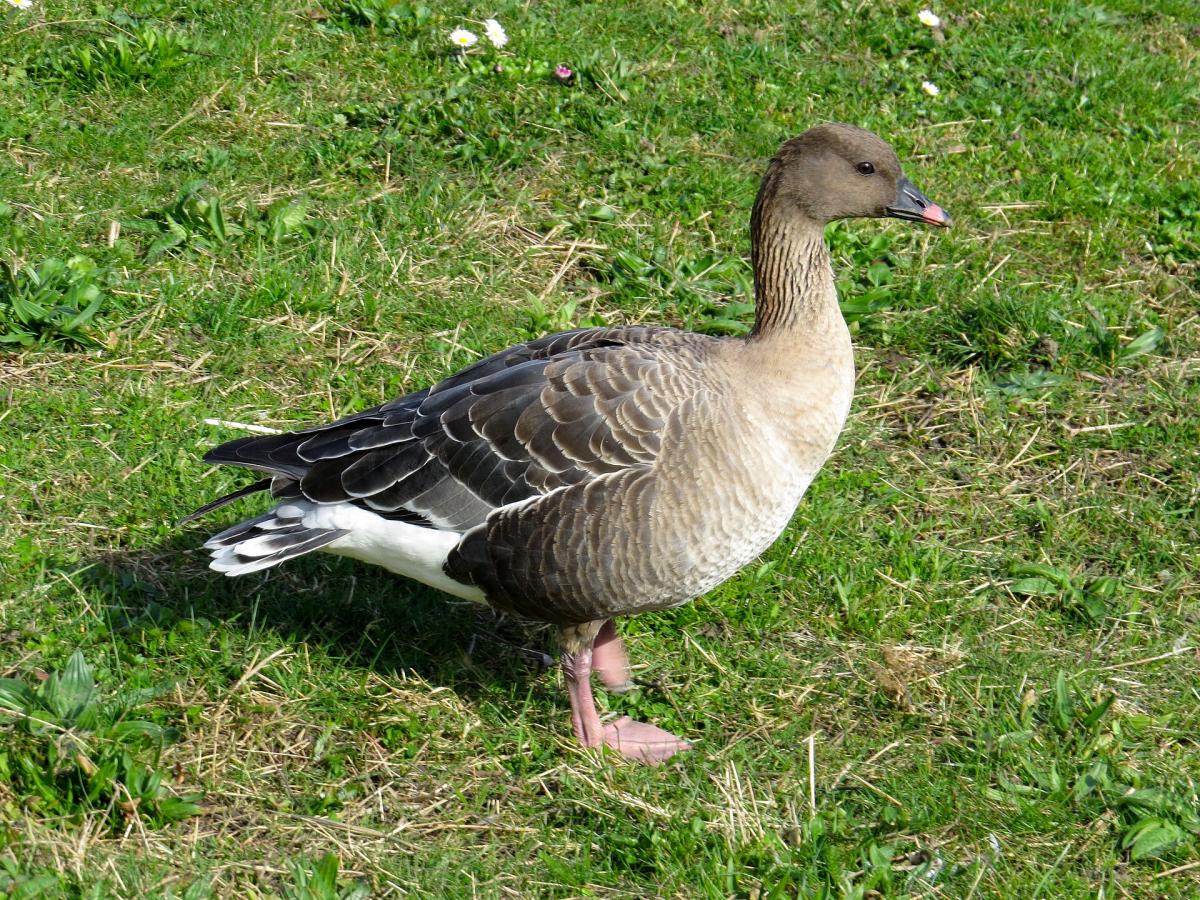
Skeins yelping across a September sky — for many people the first real sign that autumn has arrived.
A compact grey goose with a dark chocolate head and neck, a small dark bill banded with pink, and pink legs. Pink-footed geese arrive on the Solway from Iceland and Greenland in September and stay until April, feeding on stubble, grass and lifted root crops by day and roosting in huge numbers on the estuary sandflats. The Solway holds internationally significant proportions of the world population.
Behaviour
They are extremely gregarious, moving between roost and feeding fields in disciplined skeins with a high, yelping 'wink-wink' call quite unlike the greylag's cackle. The dawn flight off the estuary roost and the evening return are among the great wildlife spectacles of the Solway. Flocks are wary and shift feeding fields constantly, and rely on the safety of open sandbanks overnight.
Migration
Pink-footed geese breed in Iceland and eastern Greenland and cross the Atlantic in autumn. The entire Iceland–Greenland population winters in Britain, with the Solway one of its most important destinations — which is why disturbance and habitat change here matter far beyond the region.
When to see it
Quick facts
- Family
- Ducks, geese and swans (Anatidae)
- Size
- 60–75 cm
- UK status
- Amber-listed
Photo by MPF, CC BY-SA 4.0, via Wikimedia Commons