Redwing
Turdus iliacus
Print fact sheet (PDF)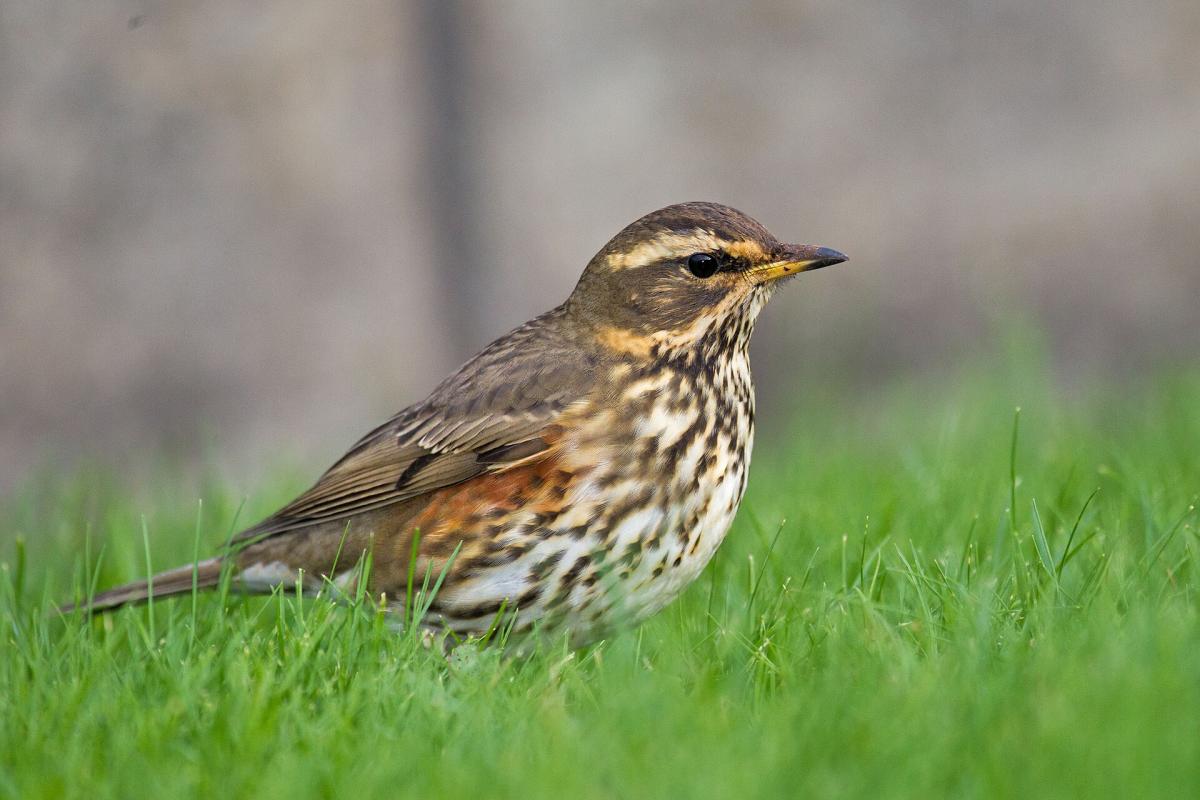
Listen on an October night — the thin 'seep' overhead is redwings arriving in the dark.
Our smallest common thrush: dark brown above, boldly streaked below, with a creamy stripe over the eye and a rusty-red patch along the flank and under the wing that gives it its name. Redwings reach Dumfries from October, usually mixed in with fieldfares, and feed on hedgerow berries and, later in the winter, on damp grassland. Most have moved back north by the end of March.
Behaviour
Redwings migrate at night, and the thin, high 'tseep' called between birds passing over a lit town in October is one of the more atmospheric sounds of the local year. By day they feed in loose flocks, more cautious than fieldfares, dropping into hawthorn and rowan and flying up together at any disturbance. In hard frosts they turn to windfall fruit in gardens and orchards.
Migration
Redwings breed in Iceland, Scandinavia and Russia, and the birds wintering in Dumfries are a mixture of both populations. They travel by night and can shift hundreds of miles mid-winter if the weather turns, so a flock feeding in a hedge one week may be replaced by different birds the next.
When to see it
Quick facts
- Family
- Thrushes (Turdidae)
- Size
- 21 cm · smaller than a song thrush
- UK status
- Red-listed
Photo by Andreas Trepte, CC BY-SA 2.5, via Wikimedia Commons