Waxwing
Bombycilla garrulus
Print fact sheet (PDF)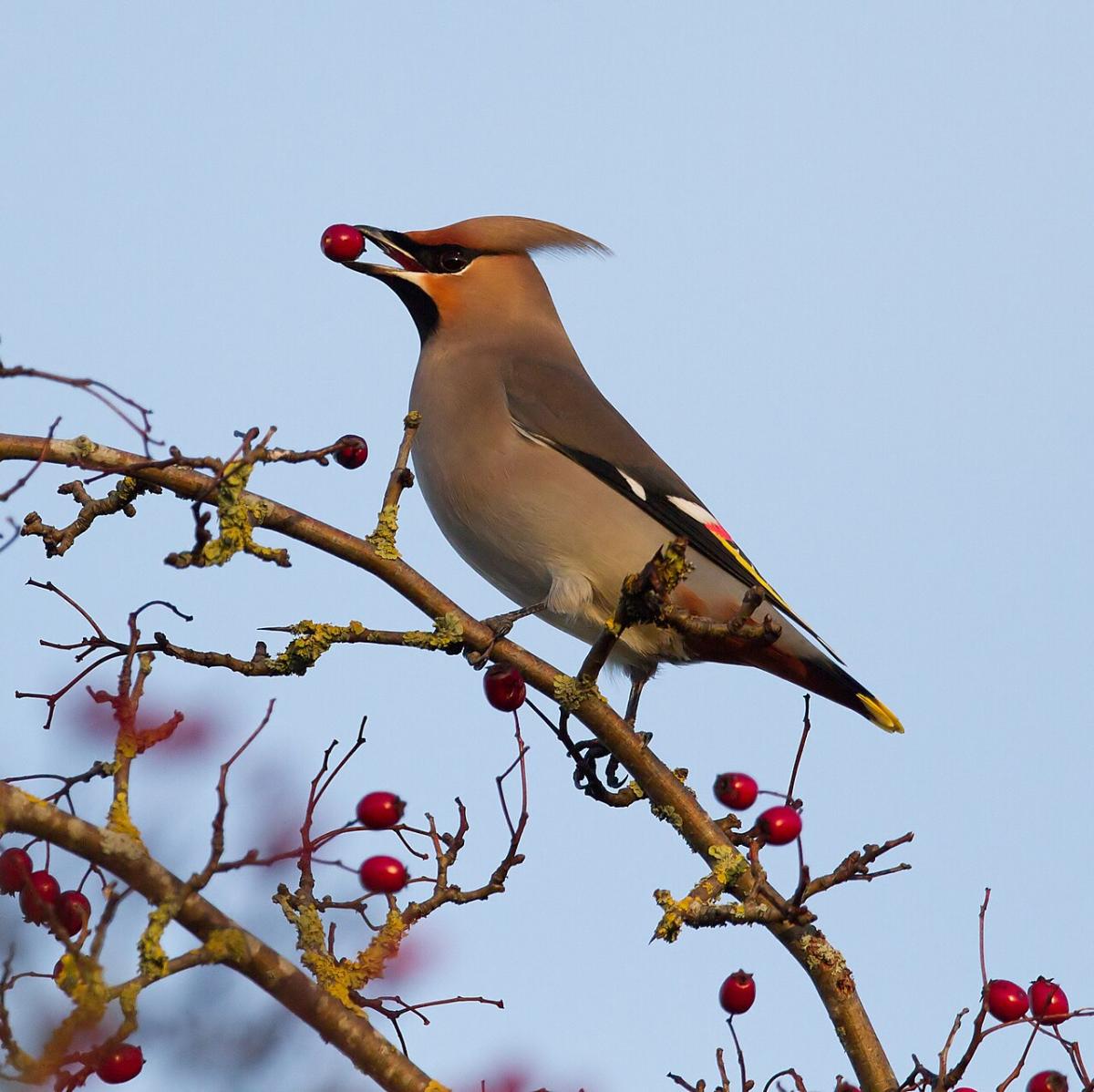
A crested, berry-loving visitor from the far north that only turns up some winters — but when it does, it arrives in style.
Waxwings are one of the most eagerly anticipated winter visitors to Dumfries and Galloway, though they don't turn up every year. This starling-sized bird is unmistakable: a soft pinkish-brown body, a jaunty crest, a black eye-mask, and wingtips finished with tiny red, wax-like tips that give the species its name. Waxwings breed far north in Scandinavia and Russia, and only cross the North Sea to Britain when the berry crop fails back home — an "irruption" that can bring flocks flooding into supermarket car parks and suburban streets wherever rowan, cotoneaster and hawthorn berries hang heavy. Some winters see none locally at all; others bring flocks of dozens, often astonishingly tame and easy to watch at close range as they strip a berry bush bare in a matter of hours. By March, whatever birds have arrived head back north to breed.
Behaviour
Waxwings feed almost entirely on berries in winter, swallowing them whole and working through a bush systematically until it's stripped clean before moving on together as a tight flock. Because they rely on an unpredictable food supply, they show little fear of people, often feeding at eye level a few metres from passers-by. Their soft, trilling call is a good way to locate a flock before you see it.
Migration
Waxwings breed in the northern forests of Scandinavia and Russia. They only reach Dumfries in 'irruption' winters, when the berry crop fails up north and hunger drives flocks west and south in search of rowan and hawthorn — which is why some winters bring hundreds and others none at all.
When to see it
Quick facts
- Family
- Waxwings (Bombycillidae)
- Size
- 18 cm · starling-sized
- UK status
- Amber-listed
Photo by Alun Williams333, CC BY-SA 4.0, via Wikimedia Commons