Hummingbird Hawk-moth
Macroglossum stellatarum
Print fact sheet (PDF)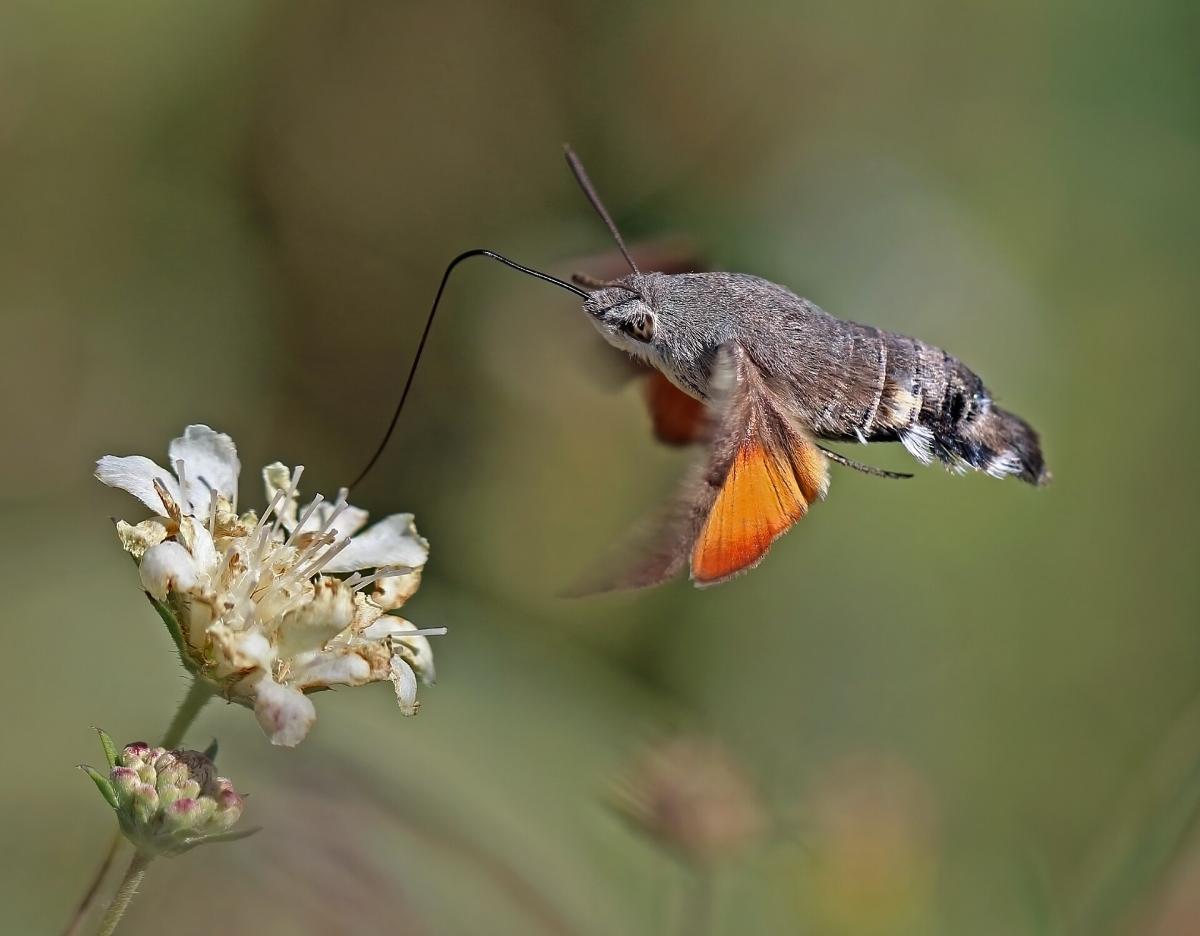
People report it as a hummingbird every year — and it does hover, hum and feed exactly like one.
A stout, fast-flying day-active hawk-moth with grey-brown forewings, orange hindwings and a fanned black-and-white tail tuft. It hovers at flowers with its wings beating fast enough to produce an audible hum, probing with a long proboscis. Hummingbird hawk-moths reach Dumfries as migrants in variable numbers, most often in late summer, and cause a flurry of mistaken hummingbird reports every year.
Behaviour
It feeds on the wing, holding a precise hover at buddleia, valerian, phlox and honeysuckle and moving between flowers in quick darts. It has excellent colour vision and a good memory for productive flower patches, returning to the same plant at the same time of day. It cannot reliably survive a Scottish winter, so almost all individuals here have flown north from southern Europe.
Migration
Hummingbird hawk-moths breed around the Mediterranean and migrate north each summer, some reaching Scotland. Warm southerly airflows produce the best years, and numbers vary enormously from one summer to the next.
When to see it
Quick facts
- Family
- Hawk-moths (Sphingidae)
- Wingspan
- 4–5 cm
- Status
- Migrant; numbers vary greatly year to year
Photo by Charles J. Sharp, CC BY-SA 4.0, via Wikimedia Commons