Large White
Pieris brassicae
Print fact sheet (PDF)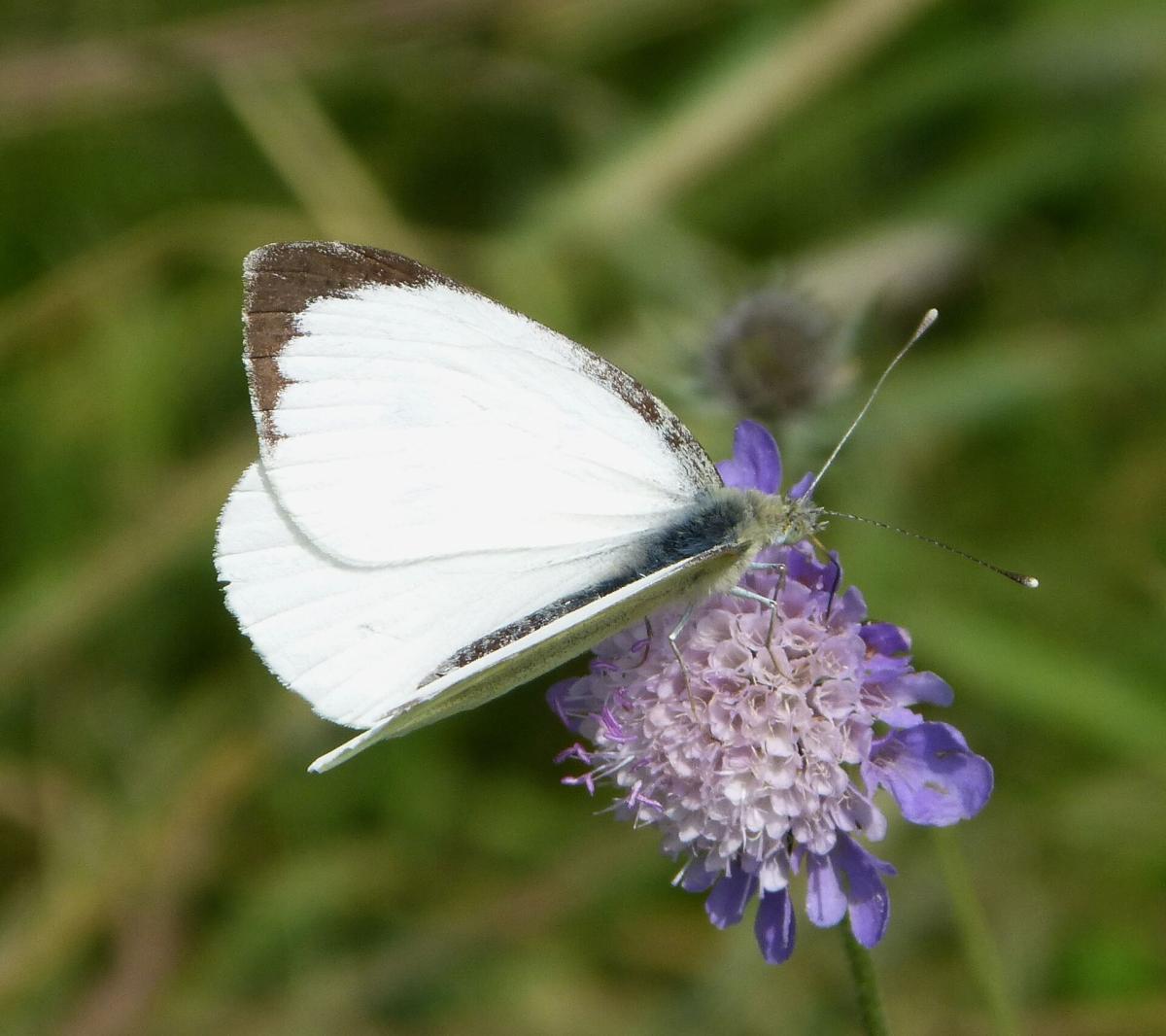
The 'cabbage white' proper — and its caterpillars really will strip a brassica bed.
Our largest white butterfly, with bold black wingtips that extend well down the outer edge of the forewing; females also carry two black spots on each forewing. Large whites are common in gardens, allotments and farmland around Dumfries, and are one of the two species gardeners mean by 'cabbage white'. Numbers are boosted in some years by migrants arriving from the continent.
Behaviour
Unlike most butterflies the large white lays its eggs in conspicuous yellow batches on the underside of brassica leaves, and the caterpillars feed gregariously — which is why damage appears suddenly and comprehensively. The caterpillars sequester mustard oils from the foodplant and are distastefully coloured black and yellow to advertise it. Many are parasitised by the wasp Cotesia glomerata.
Migration
Resident populations are supplemented in some summers by migrants crossing from continental Europe, which is why large white numbers can vary sharply from one year to the next.
When to see it
Quick facts
- Family
- Whites and yellows (Pieridae)
- Wingspan
- 5.5–6.5 cm · our largest white
- Status
- Native, with continental migrants; common
Photo by gailhampshire from Cradley, Malvern, U.K, CC BY 2.0, via Wikimedia Commons