Painted Lady Butterfly
Vanessa cardui
Print fact sheet (PDF)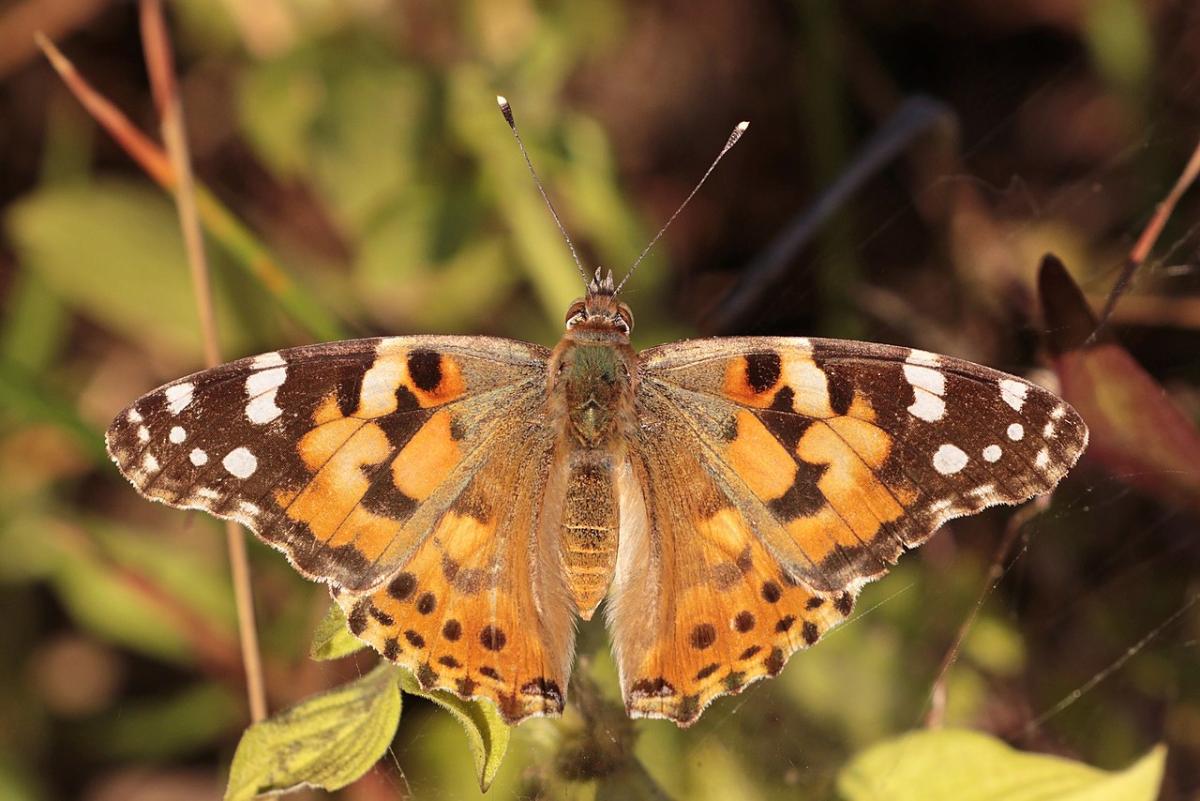
A butterfly that's flown here from the edge of the Sahara.
The painted lady is one of Britain's great long-distance travellers. Every year, waves of this orange-and-black butterfly leave North Africa and southern Europe, breeding as they go, and push north — some years reaching Dumfries in only a trickle, others arriving in the thousands. Adults typically appear from May, with numbers building through summer and peaking in early August, though a strong migration can bring sightings in almost any month. Unlike our resident butterflies, painted ladies can't survive a Scottish winter in any life stage, so every individual seen here is either a migrant fresh from the continent or the offspring of one, born on garden thistles or nettles a generation or two after the original arrival. Look for it nectaring on buddleia, knapweed and garden asters, wings held flat to soak up warmth, before an astonishing return migration south begins again in autumn.
Behaviour
Painted ladies are strong, fast fliers, covering enormous distances at altitude on favourable winds rather than drifting low like many butterflies. They bask with wings spread wide to warm flight muscles, then feed avidly on nectar-rich flowers to fuel both breeding and onward migration. Radar studies have shown that autumn-bound painted ladies fly south again at heights of a kilometre or more, a return journey largely invisible from the ground.
Migration
The painted lady can't survive a British winter in any form. Each year's butterflies descend from migrants that set out from North Africa and the Sahel, breeding in relays as they push north — a multi-generational journey of thousands of kilometres, with the autumn generation heading back south at high altitude.
When to see it
Quick facts
- Family
- Brush-footed butterflies (Nymphalidae)
- Wingspan
- 5–7 cm
- Status
- Migrant; non-resident, arrives annually in variable numbers from Africa
Photo by Charles J. Sharp, CC BY-SA 4.0, via Wikimedia Commons