Six-spot Burnet
Zygaena filipendulae
Print fact sheet (PDF)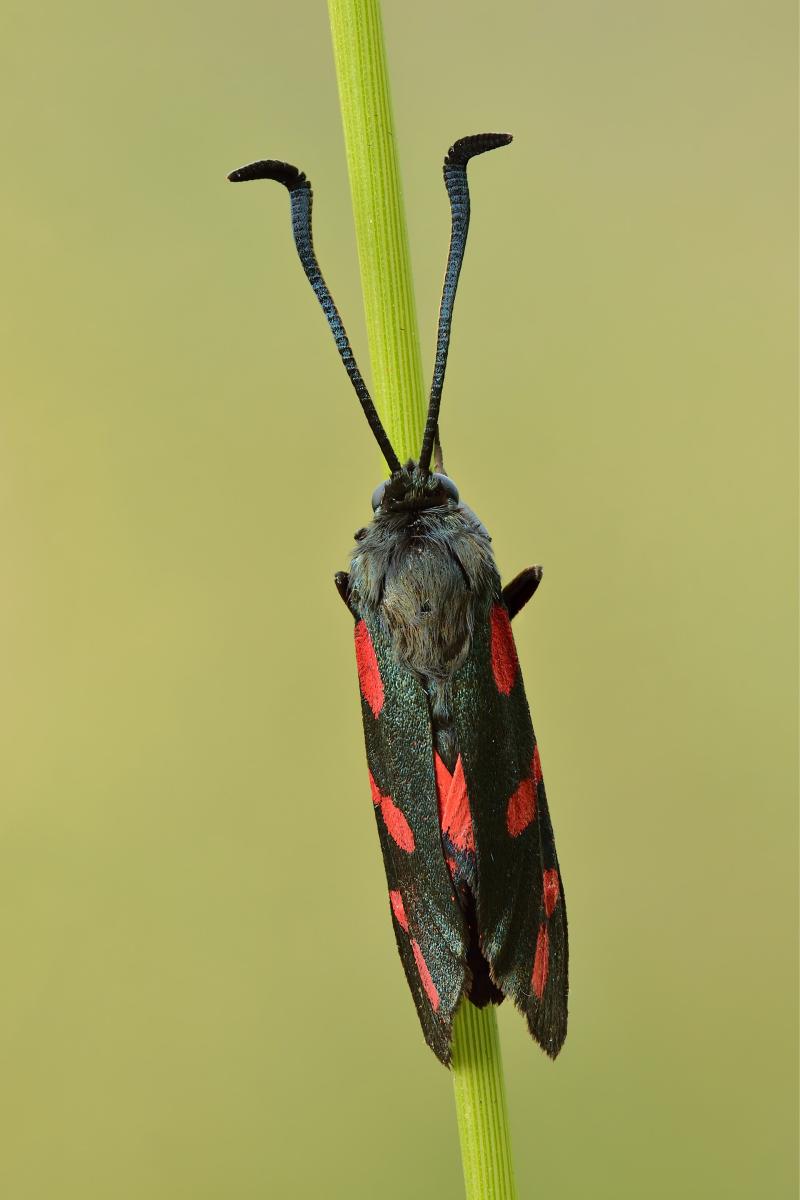
A moth that flies in bright sunshine, and can make its own cyanide.
A day-flying moth with glossy blue-black forewings bearing six crimson spots, and scarlet hindwings. It is often taken for a butterfly. Six-spot burnets live on flowery unimproved grassland, coastal dunes and verges around the Solway, where bird's-foot trefoil grows, and are often seen in numbers on knapweed and thistle heads on a warm day.
Behaviour
The bright red-on-black is a genuine warning: the moth contains hydrogen cyanide, taken up from its foodplant as a caterpillar and also synthesised by the moth itself, and it advertises this rather than hiding. The flight is slow and heavy — it has no need to be quick. Papery yellow cocoons are spun part-way up grass stems and are easy to find in early summer.
When to see it
Quick facts
- Family
- Burnet moths (Zygaenidae)
- Wingspan
- 3–4 cm
- Status
- Native; locally common on unimproved grassland
Photo by Ivar Leidus, CC BY-SA 4.0, via Wikimedia Commons