Water Vole
Arvicola amphibius
Print fact sheet (PDF)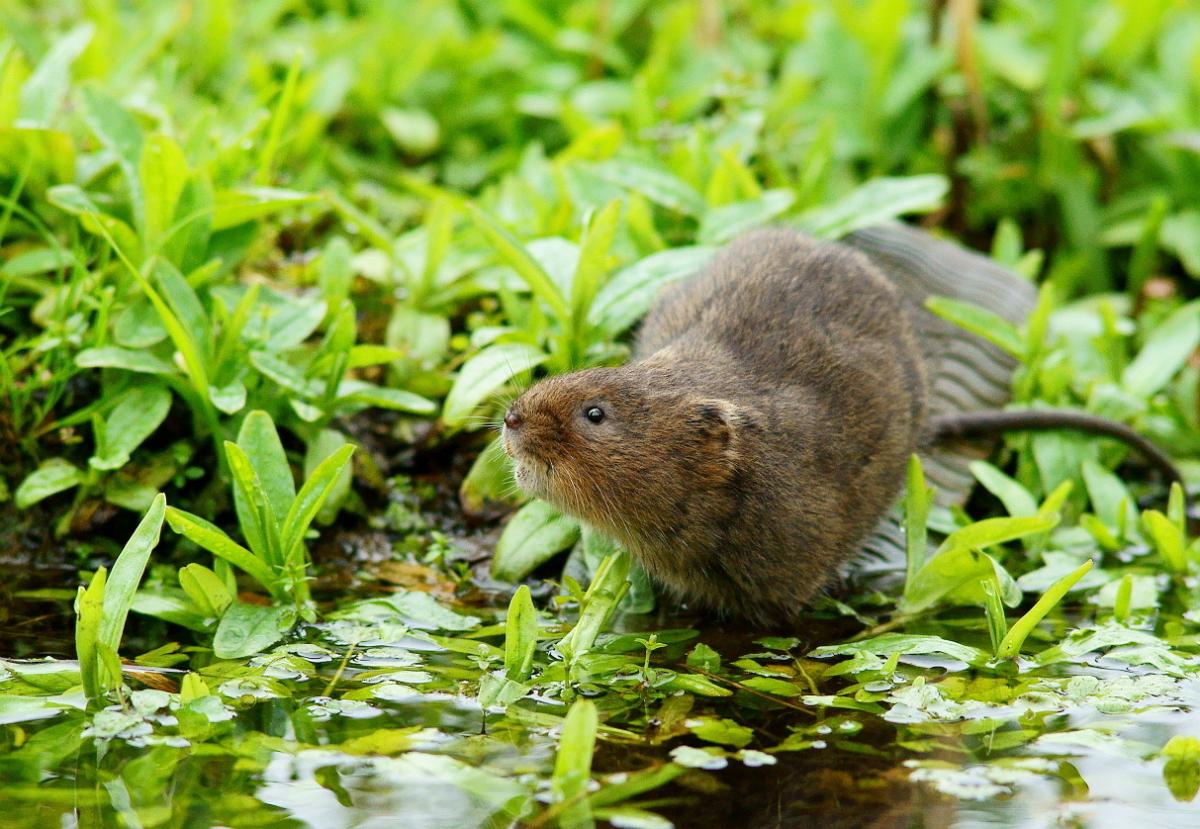
'Ratty' from The Wind in the Willows — and Britain's fastest-declining wild mammal.
A chunky, chestnut-brown to almost black rodent with a blunt rounded nose, small ears buried in fur and a furry tail — quite unlike the pointed-faced, bare-tailed brown rat it is so often mistaken for. Water voles live in steep-banked burns, ditches and slow rivers with thick bankside vegetation. They have vanished from most of their former British range and any local population is significant.
Behaviour
Water voles burrow into soft banks with entrances at and below the waterline, and graze a lawn-like patch of vegetation nearby, leaving neat 45-degree cut stems and cigar-shaped droppings at latrine sites. The characteristic sound is the 'plop' as one drops into the water. Their collapse is driven mainly by predation by American mink, an escaped fur-farm species against which the vole has no defence, compounded by loss of soft, well-vegetated banks.
When to see it
Quick facts
- Family
- Voles, lemmings and hamsters (Cricetidae)
- Size
- Body 14–22 cm plus a 9.5–14 cm tail
- UK status
- Fully protected; Britain's fastest-declining wild mammal
Photo by Peter Trimming from Croydon, England, CC BY 2.0, via Wikimedia Commons