Devil's-bit Scabious
Succisa pratensis
Print fact sheet (PDF)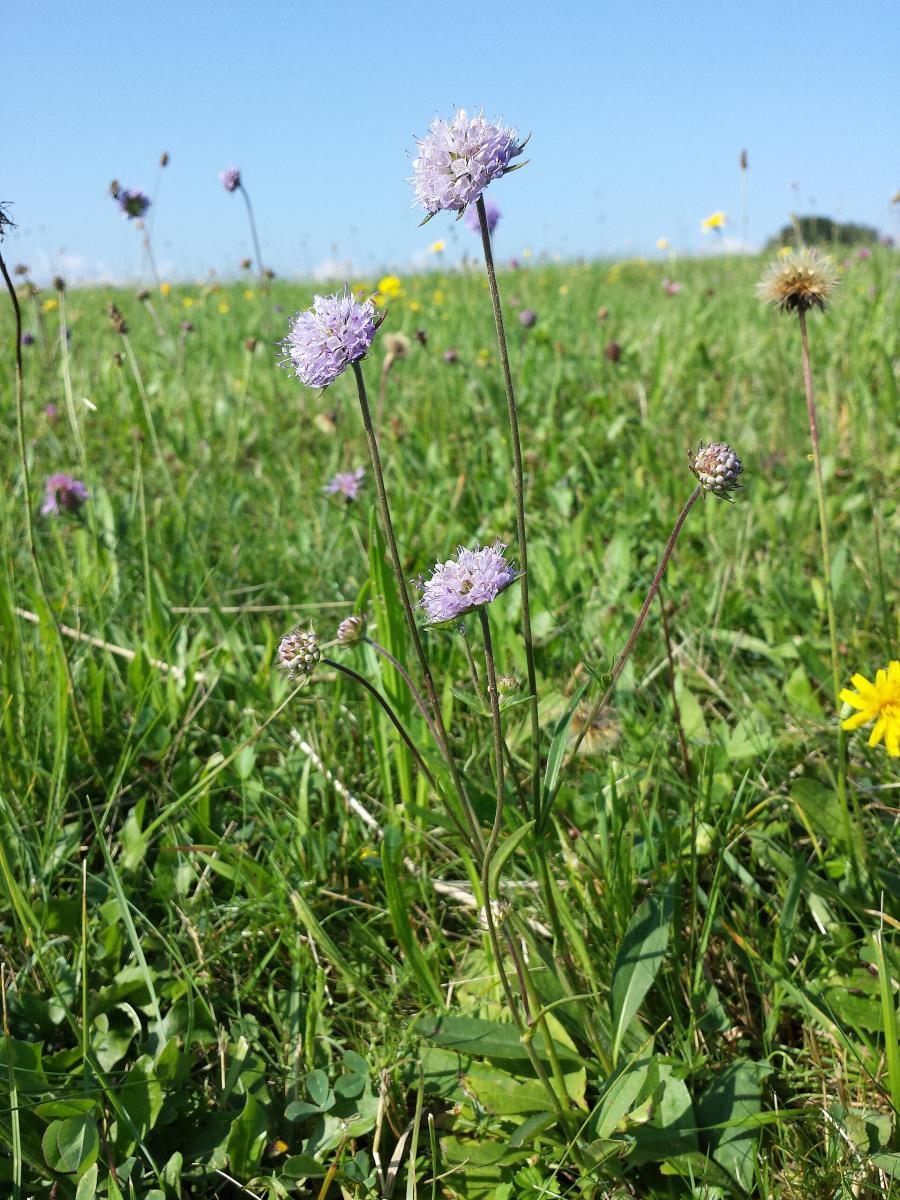
Named for a root that looks bitten off — the devil, allegedly, being annoyed at how useful it was.
A perennial of damp unimproved grassland with a basal rosette of untoothed oval leaves and rounded, domed heads of small violet-blue flowers on long stalks, the stamens standing out like pins. Devil's-bit scabious grows on damp meadows, marshy grassland, moorland edge and roadside flushes around Dumfries, flowering late into autumn.
Behaviour
The rootstock ends abruptly, as if bitten off, which is the origin of the name and the legend attached to it. Its late flowering makes it a critical nectar source in September and October for bees, hoverflies and butterflies. It is also the sole foodplant of the marsh fritillary butterfly, which is why the plant is a conservation priority well beyond its own status.
When to see it
Quick facts
- Family
- Honeysuckles (Caprifoliaceae)
- Height
- 15–100 cm
- Status
- Native; the sole foodplant of the marsh fritillary
Photo by Stefan.lefnaer, CC BY-SA 4.0, via Wikimedia Commons