Himalayan Balsam
Impatiens glandulifera
Print fact sheet (PDF)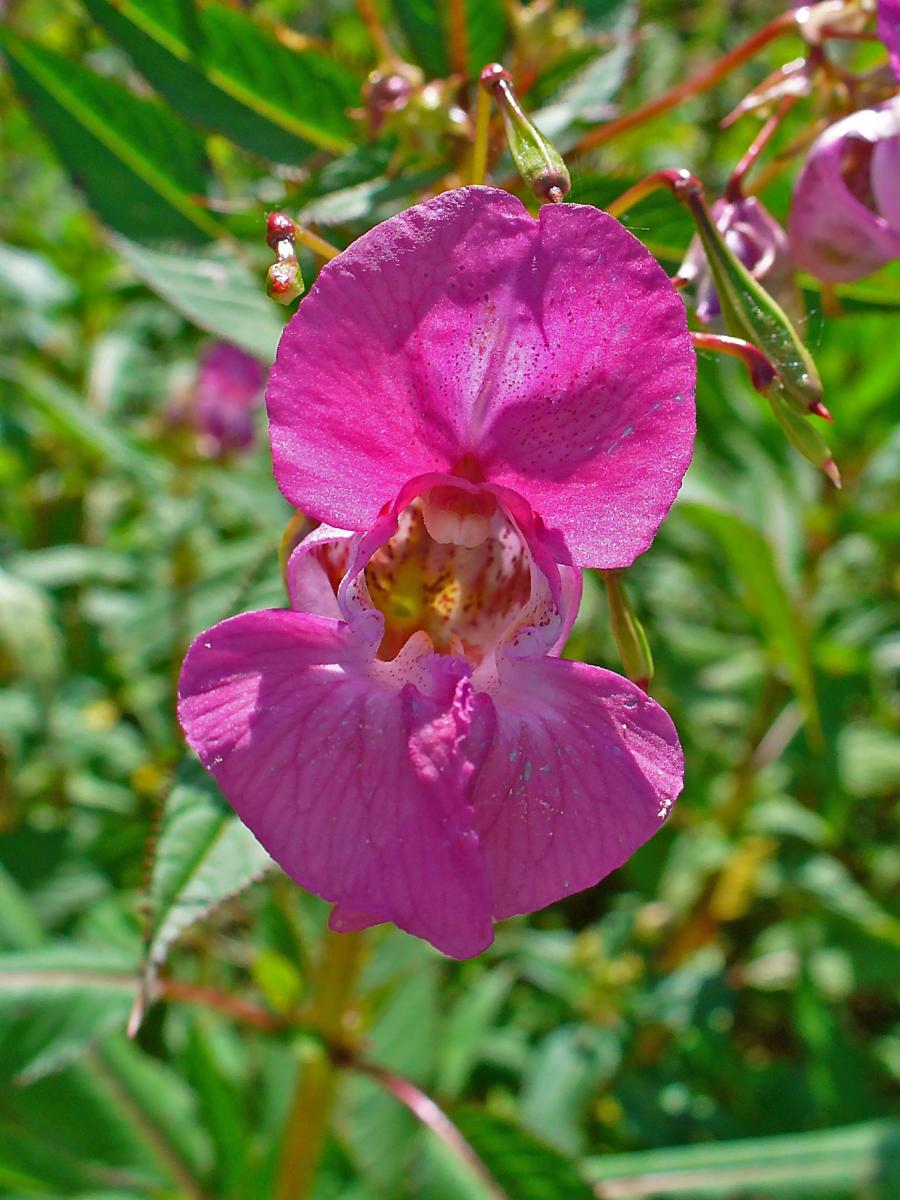
Fires its seeds several metres when touched — which is exactly why it owns the riverbank.
A tall, fast-growing annual with hollow reddish jointed stems, whorled toothed leaves and large hooded pink-purple flowers shaped like a policeman's helmet. Introduced from the Himalayas as a garden plant in the nineteenth century, it now forms dense stands along the Nith and its tributaries and on damp waste ground around Dumfries.
Behaviour
Ripe seed capsules explode at a touch, flinging seed up to seven metres — and into the water, which carries it downstream, so a single upstream plant can seed an entire catchment. It grows faster and taller than native riverbank plants and shades them out, then dies back completely in winter, leaving bare soil that erodes into the river. Control means pulling it before it seeds.
When to see it
Quick facts
- Family
- Balsams (Balsaminaceae)
- Height
- Up to 2.5 m
- Status
- Invasive non-native; illegal to plant or cause to grow in the wild
Photo by H. Zell, CC BY-SA 3.0, via Wikimedia Commons