Wild Teasel
Dipsacus fullonum
Print fact sheet (PDF)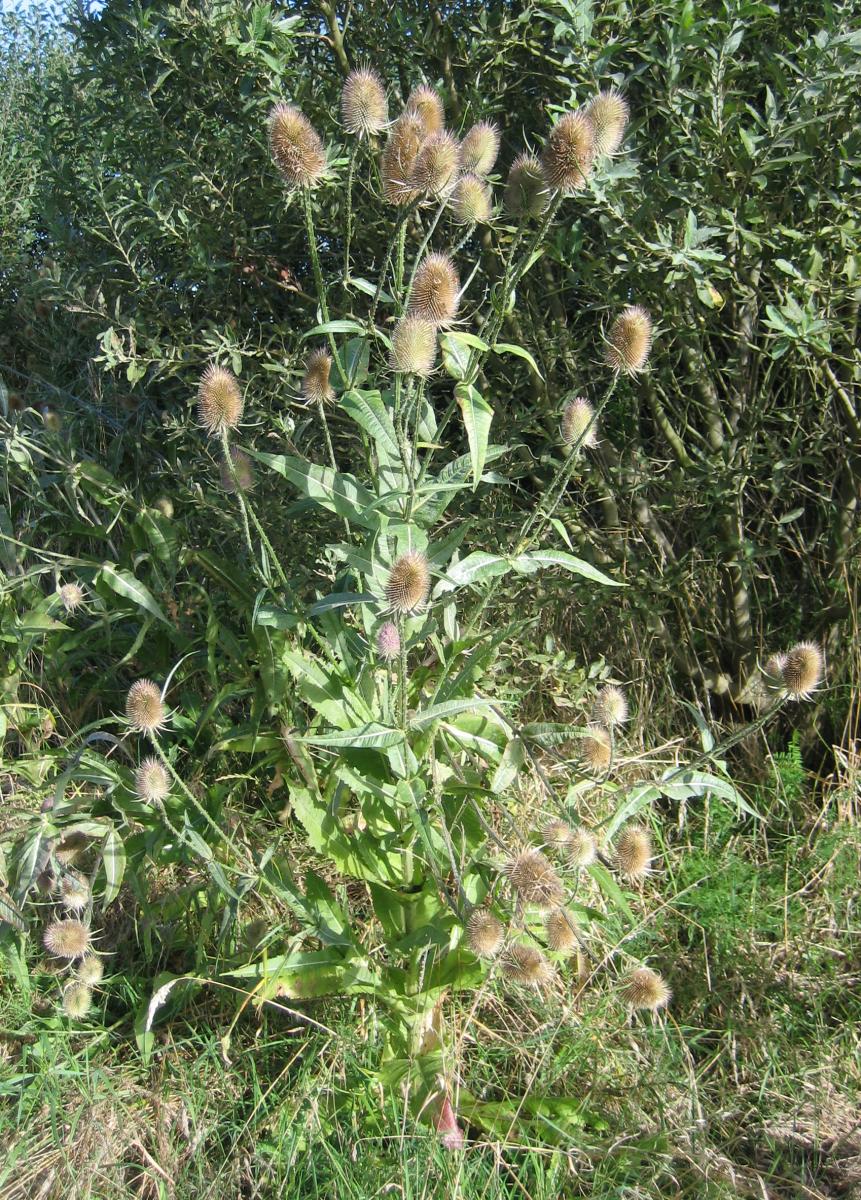
Its paired leaves hold a cup of rainwater — and goldfinches work the seedheads all winter.
A tall, prickly biennial with a spiny stem and conical flower heads of small lilac flowers that open in a band which travels up and down the head. The paired stem leaves are joined around the stem to form a cup. Teasel grows on rough ground, verges, riverbanks and damp waste ground around Dumfries, and the dead seedheads stand all winter.
Behaviour
The joined leaves hold rainwater, and there is evidence that drowned insects in those cups benefit the plant's seed production. The flowers open in a narrow ring that moves up and then back down the head, so a single teasel shows a distinct band of colour. In autumn and winter the spiny seedheads are a favourite of goldfinches, whose fine bills can reach the seed.
When to see it
Quick facts
- Family
- Honeysuckles (Caprifoliaceae)
- Height
- 100–200 cm
- Status
- Native; common on rough and damp ground
Photo by MPF, CC BY-SA 3.0, via Wikimedia Commons