FixMyStreet: 6 months in
By Gilbert West · 28 September 2026
Reporting a broken slab, a flickering streetlight or a pothole in Dumfries is now a smoother process. You'll see if a neighbour got there first and get a message when it’s fixed.

What’s changed
Since spring 2026, Dumfries & Galloway Council has taken reports of problems with the things we all use to get about town, from roads, pavements and cycle paths to streetlights, road signs and roadside trees, through one website: repair.dumfriesandgalloway.gov.uk. It replaced the council’s old Enquiry Service for these reports. A soft launch began on 18 March, and the public rollout followed on 1 April.
As we approach the first 6 month milestone I thought I'd have a look to see if things are being fixed.
The site runs on FixMyStreet Pro, built by SocietyWorks, the commercial arm of the civic-tech charity mySociety. FixMyStreet has been a way for people to report local problems across the UK for years. What’s new for us is that our Council now runs it as well.
How to report a problem
- Go to repair.dumfriesandgalloway.gov.uk and enter a postcode or street name, or use your current location.
- Put the pin on the map exactly where the problem is.
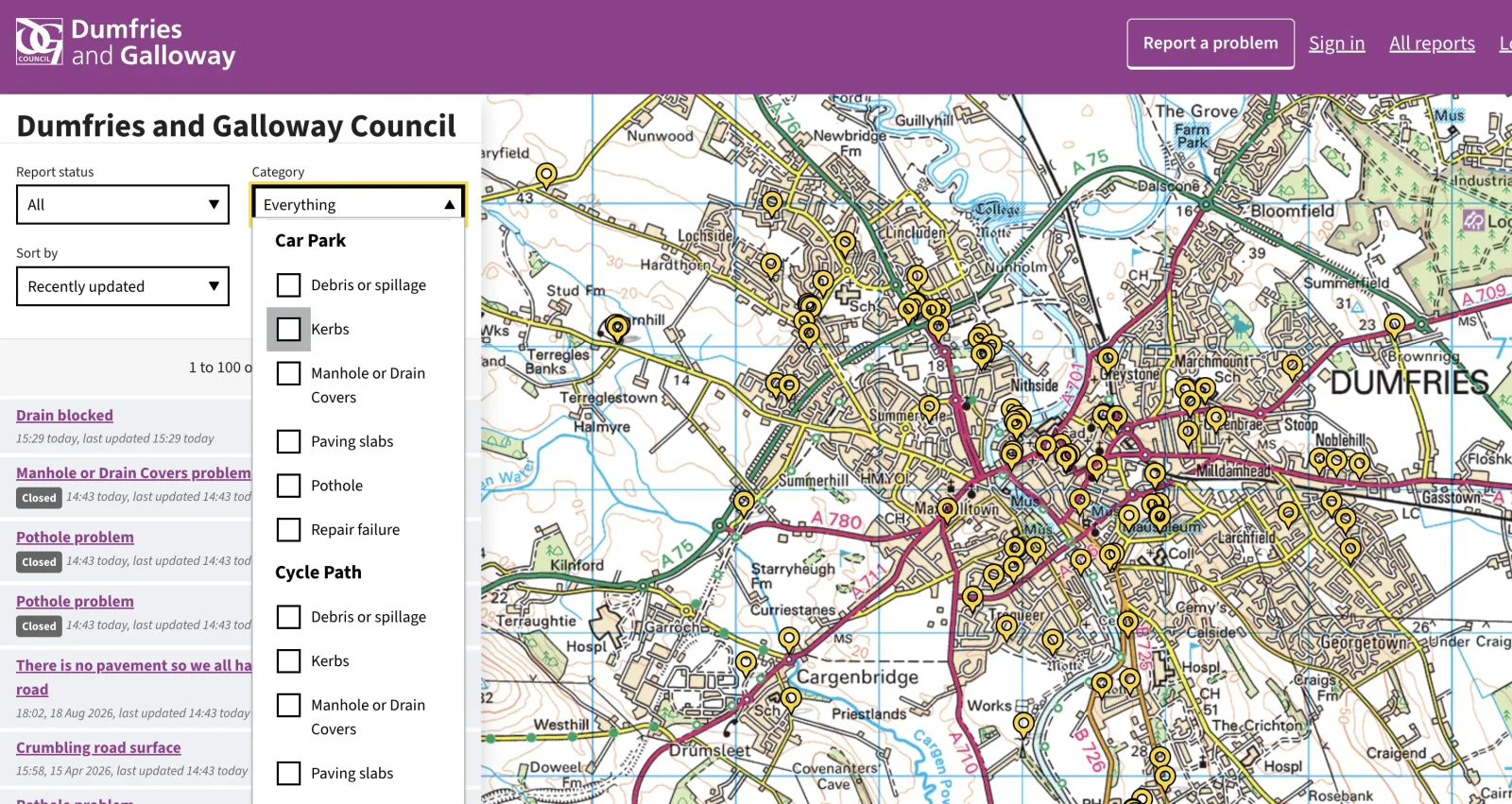
- Look at the pins already there. If your problem is one of them, you can follow that report instead of making a new one.
- Choose the type of problem, add a photo and a short description, and send it.
You can report problems with roads, pavements and cycle paths, road signs, street lighting, and roadside trees and verges. There’s even a “repair failure” option for a fix that hasn’t lasted.
It only covers things the council is responsible for, so private roads and paths, large shopping centres etc aren’t included.
What residents noticed
You get an acknowledgement
Report gets a confirmation and a reference number. The reports progress is live on the website along with responses.
You’re told if someone got there first
Existing reports appear on the map. When you report something, the site suggests possible duplicates nearby in the same category. Rather than reporting the same broken light again, you can sign up for updates on the report that’s already there.
The council is clear that more reports won’t get a problem fixed any faster. The point is that everyone who cares about that pothole, pavement or streetlight hears what happens to it. Also, councillors don't get preferential treatment. Things you report carry the same weight as a councillor reporting something.
You hear when it’s fixed
When the work is done, the original reporter and anyone following the report are told automatically, and the update can include a photo of the finished repair. That closes the loop that used to be missing: you reported it, and now you know it’s done.
Behind the map
FixMyStreet is built around Open311, an open standard for sending civic problem reports between systems. Your report doesn’t land in an inbox waiting to be retyped. It goes straight into Causeway One, the system the council’s roads team uses to manage its roads and assets, and the status updates come back the same way.
Their map also shows planned roadworks and utility works from the Scottish Road Works Register. Faults are graded by priority, and the most urgent (priorities 1 to 3) appear on the map. Lower-priority ones (4 and 5) are logged but not shown.
“We wanted a solution that makes it easier for residents to report problems, improves the accuracy of information we receive, and provides greater openness and transparency around how reports are managed.”
— Dumfries & Galloway Council’s roads maintenance manager
How do the numbers stack up?
In its first six months, FixMyStreet logged 20,115 reports across Dumfries & Galloway.
| Status | Reports | Share |
|---|---|---|
| Fixed | 5,083 | 25% |
| Closed | 5,130 | 26% |
| Still open | 9,902 | 49% |
| Total | 20,115 |
That’s more than 10,000 reports dealt with, about half of everything reported. “Closed” isn’t the same as fixed: a report can be closed because it duplicates another one, because the problem isn’t the council’s responsibility, or because it was inspected and no work was needed.
Figures from the council’s FixMyStreet reports page on 27 September 2026.
Everything in the open
What’s significant isn’t just the number of reports and fixes. It’s that every single issue is listed and available for the public to scrutinise: the open ones as well as the fixed ones. You see where the problem is, when it was reported and what has happened since.
Under the old system, a report went in and, as far as the public could tell, disappeared. Now you can open the reports page for your street, your ward or the whole region and see what’s outstanding, what’s been done and how long it took. 9,902 open reports is not a flattering number to publish, and the council publishes it anyway.
Tips for a good report
- Put the pin exactly on the problem. On a long road or a row of lamp posts, it’s the difference between a crew finding the right one and not.
- Add a photo, ideally with something beside it for scale. For a streetlight, the number on the post helps.
- Check the map first, and follow an existing report rather than adding a duplicate.
Have a go yourself. Report a problem to Dumfries & Galloway Council